Key Insights
- Cargo type, not trailer length, should drive the specification. A 40-foot flatbed hauling steel coils and a 40-foot flatbed hauling granite blocks are structurally different vehicles.
- Concentrated loads are the real engineering challenge. A 20-tonne coil resting on two metres of deck imposes far greater stress than 20 tonnes spread across the full platform.
- Mechanical suspension suits dense, rigid cargo; air suspension protects fragile or high-value loads. Choosing wrong costs you either in cargo damage or in unnecessary capital.
- Deck height determines what you can legally and safely carry. Standard, low-deck and step-deck configurations each unlock a different range of cargo.
- Lashing points and deck material are not accessories. They are load-securing infrastructure, and inadequate provision is a leading cause of in-transit cargo shift.
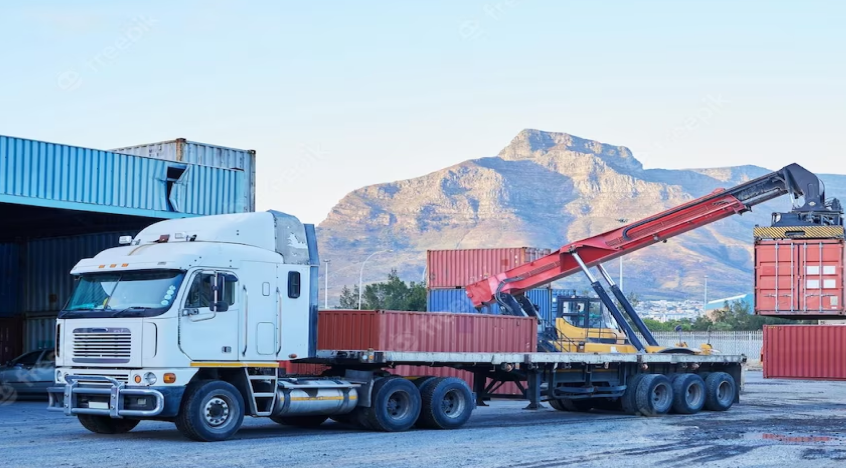
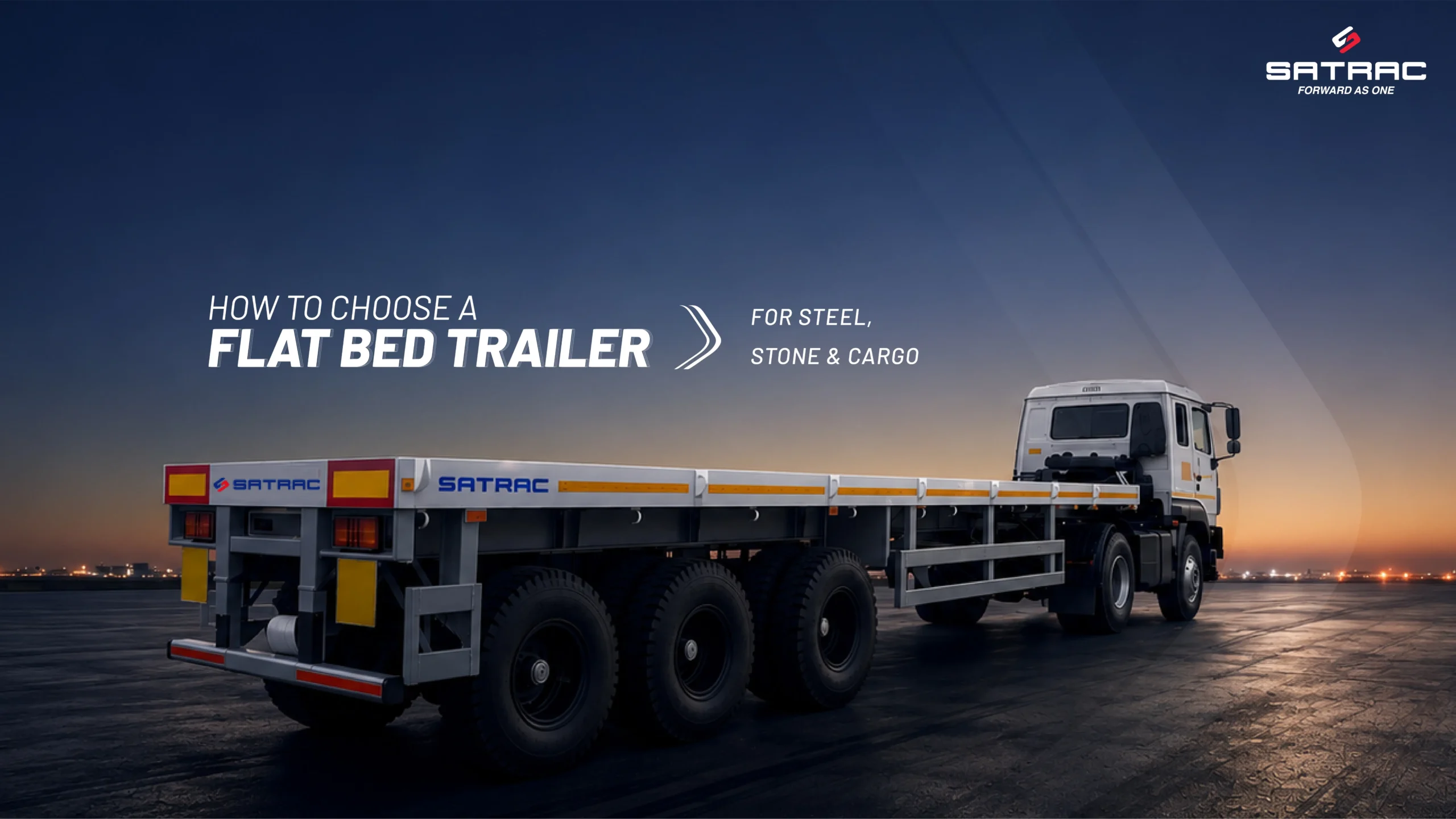
For all its apparent simplicity, the s one of the harder vehicles to specify correctly. There is no enclosure, no tipping mechanism, no discharge system. Just a deck, a chassis, and a suspension. Which is precisely why the engineering underneath matters so much: with nothing to hide behind, every specification decision shows up directly in how the vehicle performs.
Fleet owners often approach the purchase by length and payload rating alone. Forty feet, forty tonnes, done. But two trailers built to the same headline numbers can behave completely differently under load, and the difference reveals itself in the fifth year, when one is still running true and the other has developed deck deflection, weld fatigue, or chronic tyre wear.
The right question is not how much can it carry. It is what exactly will it carry, and how does that cargo behave in transit.
Start with how your cargo distributes weight
This is the single most important variable, and the one most commonly overlooked.
A flatbed carrying palletised goods distributes weight fairly evenly across the deck. The chassis sees a broadly uniform load, and stress is shared along the length of the main beams. A flatbed carrying steel coils sees something entirely different. A single coil concentrates its full mass onto a narrow footprint, sometimes just a metre or two of deck. The load path is intense, localised, and repeated with every journey.
Two trailers rated for identical gross payload will handle these two scenarios very differently. The first needs adequate overall strength. The second needs reinforced cross-members and a beam section engineered specifically for point loading, because concentrated load is what causes deck deflection and, over time, fatigue cracking at weld joints.
Before any other decision, establish three things about your cargo:
Density. Steel and stone are dense. They reach maximum weight while occupying relatively little deck space, which concentrates stress. Machinery, packaged goods and construction materials are less dense and distribute more naturally.
Load footprint. Does the cargo sit on a wide, flat base, or on a narrow contact area? Coils, transformer bases and stone blocks concentrate. Crated goods and palletised freight spread.
Loading method. Overhead crane loading places cargo vertically with minimal lateral force. Side loading and forklift loading impose horizontal stresses on the deck edge and require different edge reinforcement.
Match the deck to the material
Steel coils are the demanding case. Coil transport typically requires a coil well or dedicated cradle arrangement, because a coil left to rest on a flat deck is both a stress concentration problem and a securing problem. Reinforced cross-members through the coil-bearing section are essential, not optional. Fleet operators running steel corridors for producers like Tata Steel or JSW know that coil trailers live a harder life than almost any other flatbed application.
Granite, marble and stone blocks combine extreme density with abrasive contact and often irregular base geometry. The deck material matters here as much as the chassis. Hardwood decking absorbs point contact and resists the gouging that stone edges inflict on steel plate. Stone also tends to be loaded by heavy equipment in quarry conditions, so edge strength and underbody clearance need attention.
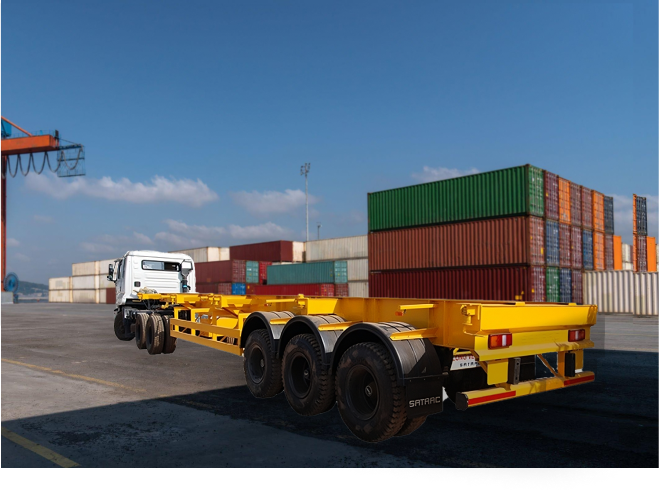
Containers demand a different approach entirely. If your work is predominantly container haulage, twist locks are essential, and it is worth honestly assessing whether a skeletal trailer would serve you better. Skeletal designs are lighter, which means more payload, and they are purpose-built for ISO container carriage. A flatbed with twist locks is a compromise that makes sense only if containers are a secondary rather than primary application.
Project cargo and machinery covers transformers, generators, structural steel and plant equipment. This category is defined by variety, which means the specification needs flexibility: comprehensive lashing provision, adequate deck width, and often a lower deck height to keep tall loads within legal limits. Where the cargo is genuinely oversized or exceptionally heavy, a semi low bed trailer rather than a flatbed is usually the correct vehicle.
TMT bars and long steel distribute reasonably well along the deck but create securing challenges because of length and the tendency of bundles to shift. Lashing point spacing and deck length become the controlling specifications.
Choose the deck height deliberately
Deck height determines the total height of your loaded vehicle, and total height determines what routes you can legally run.
Standard deck works for the majority of cargo where load height is not near the legal limit. It is the simplest and most versatile configuration.
Low deck buys you vertical clearance. If you regularly carry tall machinery or stacked cargo, a lower deck is what keeps the loaded vehicle within height regulations without reducing what you can carry.
Step deck provides two deck levels, allowing taller cargo on the lower section while retaining full-height capacity over the gooseneck. For fleets carrying a genuinely mixed portfolio, this flexibility often justifies the added complexity.
The decision should be driven by your tallest regular load, not your average one. A trailer that cannot legally carry your occasional high-value oversized job forces you to subcontract exactly the work with the best margins.
Get the suspension right
Suspension choice is where cargo type and operating environment intersect, and where fleet owners most often default to habit rather than analysis.
Mechanical suspension uses leaf springs and is robust, simple, and economical to maintain. For dense, rigid cargo that is indifferent to ride quality (steel, stone, construction materials) and for operations involving rough site access, mechanical is frequently the right and more economical answer.
Air suspension provides a substantially smoother ride, protects fragile or high-value cargo, and allows deck height adjustment for loading. It also treats the cargo, the trailer and the road surface more gently. For machinery, electronics, glass, project equipment and anything where in-transit vibration is a genuine risk, air suspension usually earns its premium.
The considered question is not which is better. It is what your cargo can tolerate and what your routes demand.
Axle configuration follows the same logic. Tandem axles suit lighter payloads and cost less; tridem configurations spread load across three axles, which matters both for higher payloads and for compliance with axle-load limits. Get this wrong and you either sacrifice payload capacity or run into regulatory problems at weighbridges.
Do not underestimate the securing system
Load securing is where flatbed operations most often fail, and it is a specification issue as much as an operational one.
Because a flatbed has no walls, every kilogram of cargo is held by the securing system alone. That places real demands on lashing point specification: rated capacity, spacing along the deck, and positioning relative to typical cargo footprints.
Under-specified lashing provision is a genuine safety issue and a frequent cause of load shift, cargo damage and roadside penalties. When comparing trailers, ask for the rated capacity of the lashing points and their spacing, not just the count. Ten well-positioned, properly rated points are worth more than twenty inadequate ones.
Deck material matters here too. Hardwood decking provides better friction against cargo bases than bare steel, which meaningfully reduces the tendency to shift under braking and cornering.
What separates a good flatbed from an adequate one
Once you have the configuration right, build quality determines whether the trailer holds its geometry over a decade of service. Three things do most of the work.
Steel grade. High-strength steel with a yield strength around 450 Mpa allows a given structural performance to be achieved with less material. That means a lighter trailer, which means more payload within the same gross vehicle weight, and a better strength-to-weight ratio overall.
Weld quality. Automated submerged-arc welding and MG Welding produces consistent, repeatable welds. On a flatbed subject to concentrated and repeated point loading, weld consistency is not a detail.
Alignment. Precision jigs ensure the chassis is built true. Alignment drift shows up as uneven tyre wear, and across a fleet the cumulative cost of premature tyre replacement is substantial.
None of these are visible at delivery. They become visible over years, in the form of problems that do not occur.
A practical specification checklist
Before you commit to a build, be able to answer:
- What is the heaviest single item, and what is its contact footprint on the deck?
- Is the load concentrated or distributed?
- What is the tallest load, and does that push the loaded vehicle near height limits?
- How is cargo loaded: overhead crane, forklift, or side loading?
- What proportion of journeys involves unpaved or site access?
- Is cargo vibration-sensitive?
- What lashing capacity and spacing does the cargo actually require?
- Are the routes primarily highway, or mixed with rough access?
If the answers point in genuinely different directions across your work, the honest conclusion may be that one trailer specification cannot serve all of it well. Specialising two vehicles usually outperforms compromising one.
Specify for the work, not the average
The recurring error in flatbed procurement is specifying for the typical job rather than the demanding one. The typical job is comfortably within the capability of almost any trailer. It is the difficult load, the concentrated one, the tall one, the awkward one, that separates a trailer that performs from one that merely functions.
Satrac builds flat bed trailers configured to the cargo they will actually carry, using BSK 46 high-strength steel, formed beams, and fully automated SAW welding, engineered through our design and manufacturing process for a service life measured in decades rather than years.
To specify a flat bed trailer for your cargo profile and route conditions, speak to a Satrac specialist.